
Flip the Script on Insurance Denials
A 10% denial rate isn't a cost of doing business. It's a strategic failure.
OutClaim is a claims enforcement platform designed to get healthcare organizations paid — pragmatically, consistently, and at scale.
Early-access pricing available · No obligation
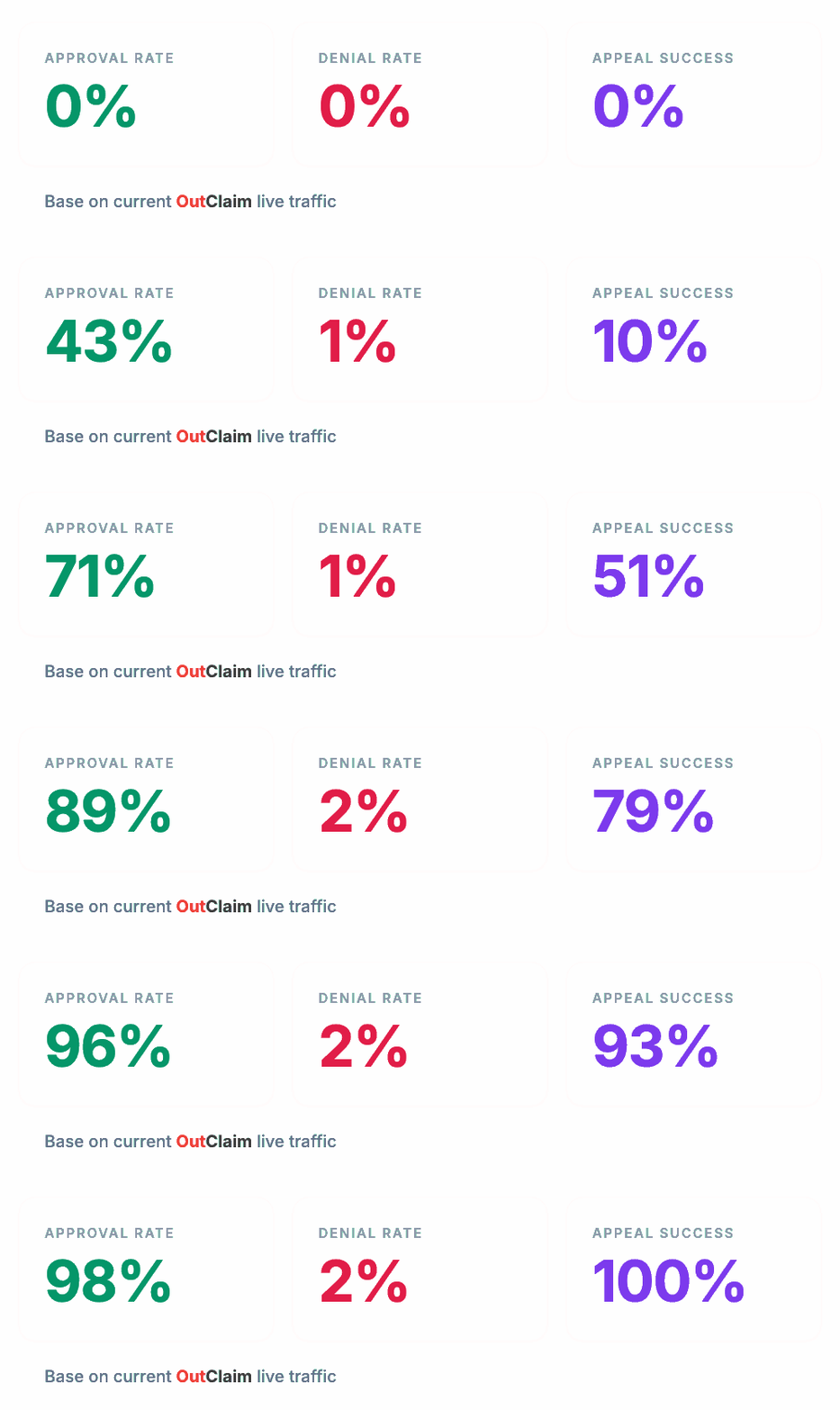
Fifteen years of reimbursement experience, applied to every case
When you engage OutClaim, you engage a physician-built strategic framework for insurer engagement, developed over 15 years of successful reimbursement experience. The system dynamically generates case-specific strategies using AI as the delivery mechanism.
OutClaim removes insurer interpretation and discretion by replacing ambiguity with specificity, opacity with transparency, and requests with obligation.
This is not about fighting insurers. It's about removing their ability to reinterpret your work.
We help providers play the game better — by flipping the script on who's in control.
The Battle Is Lost Before It Begins
This isn't because provider teams are underperforming. Highly capable billing and revenue cycle teams are operating inside an insurer-designed system that:
Revenue loss doesn't happen at the denial
It happens upstream — when vague records, verbal assurances, and insurer-controlled processes define the engagement.
Insurers, by contrast, operate with precision — using delay, vagueness, invented processes, and burden-shifting to control outcomes.
The result is an insurer-defined response loop. They define the moves; providers are trained to react.
It's predictability — in their favor.
It appears neutral. It appears fair. It isn't.
Highly capable teams are operating inside a claims and appeals system designed by insurers. It appears neutral. It appears procedural. It appears fair. It isn't.
- Precision
- Specificity
- Rule fluency
- Ambiguity
- Reaction
- After-the-fact justification
These two systems do not — and cannot — produce equal outcomes. This is not a pain point. It is a chronic, structural condition.
Built on Authority, Not Templates
OutClaim replaces reactive claims behavior with a proactive, authority-based engagement model. At a high level, OutClaim:
Acts pragmatically
By creating strategies that get providers paid and put providers in a position of leverage.
Creates transparency
By obligating insurers through insurer-specific, written records, grounded in governing rules and clinical authority.
Establishes accountability
By enforcing insurer disclosure and compliance requirements — eliminating interpretation in favor of existing rules and the law.
The correspondence doesn't ask for approval. It establishes obligation.
Prior authorization. Records requests. Appeals.
One system for the whole engagement, from the request you make before the service to the appeal you file after a denial. The earlier the case enters, the more leverage you keep — which is why OutClaim starts at prior authorization, not at the denial.
Prior authorization
The authorization request is where the record either establishes medical necessity or quietly leaves the payer room to reinterpret it later. OutClaim writes it so there is no room.
- Finds the policy that actually governs. The payer's own coverage policy, the delegated vendor's rule book where utilization management is outsourced, or the CMS national and local coverage determinations a Medicare Advantage plan is legally bound to follow.
- Checks the record before you submit. Each criterion in that policy is tested against your documentation — met, not met, or not determinable — and the missing item is named while there is still time to get it.
- Cites the criterion and quotes the record. The request states the plan's own standard, then the line in the chart that satisfies it, code by code.
- Starts the clock. The response deadline is set by the framework that governs the plan — ERISA, Medicare, Medicaid, Tricare or FEHB — and by whether the request is standard or expedited.
- Records the answer per code. An approval on one CPT and a denial on another is recorded as exactly that, so the appeal targets what was actually refused.
Response to medical records requests
A records request is a short clock and a vague ask — and an unanswered or partly answered one becomes the payer's reason to deny. OutClaim turns it into a documented, closed loop.
- Reads the payer's letter. Upload the correspondence and OutClaim extracts what was actually requested, the dates it covers and the deadline it sets — then shows you what it found so you can confirm it before anything is built on it.
- Assembles the response against the request. Operative reports, office notes and test results are pulled from records already on the patient, or uploaded if the request reaches past what you hold.
- Answers item by item. The response states what was asked, what is enclosed, and where in the enclosure it sits — so nothing can later be characterized as missing.
- Tracks the right deadline. Medicaid distinguishes electronic from paper submission and uses ADR terminology rather than MRR; the clock reflects the rule that applies, not a generic default.
- Leaves a record of compliance. What was sent and when becomes part of the case history — the evidence that answers a later claim of non-response.
Appeals, at every level
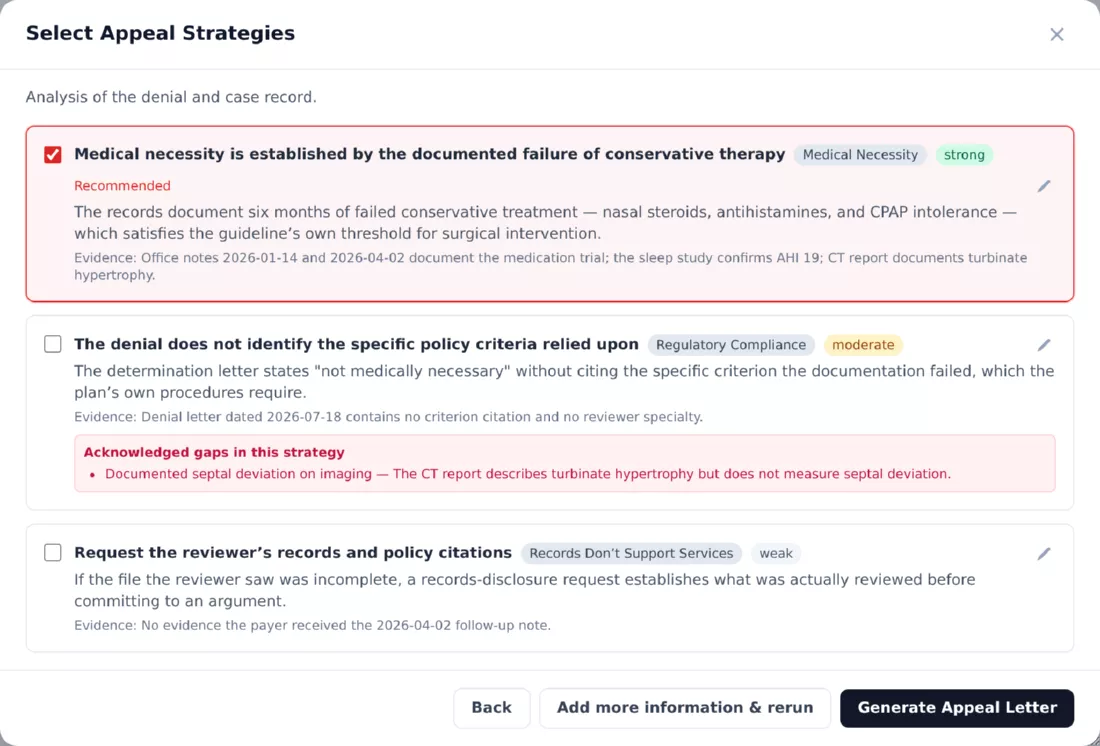
When the denial comes, the arguments available to you are already determined by what is in the record and what the plan is bound by. OutClaim finds them and puts them in writing.
- Reads the denial. The stated reason, the criterion invoked, and — just as often — the criterion the payer failed to identify at all.
- Proposes the arguments that exist. Ranked by strength, each with its supporting evidence, and with any acknowledged gap stated plainly rather than hidden.
- Establishes standing correctly. Who may file, and on what authority, differs by framework; OutClaim applies the rule for the coverage in question instead of asking for a document that isn't required.
- Escalates. First level, second level, and on to the Medicare Appeals Council, OPM, DHA or a state fair hearing — with each level's deadline tracked as it opens.
Stop Asking. Start Establishing Obligation.
OutClaim turns complex insurer policies, ERISA requirements, and standards of care into enforceable written correspondence — automatically, consistently, and at scale.
Every case, one view
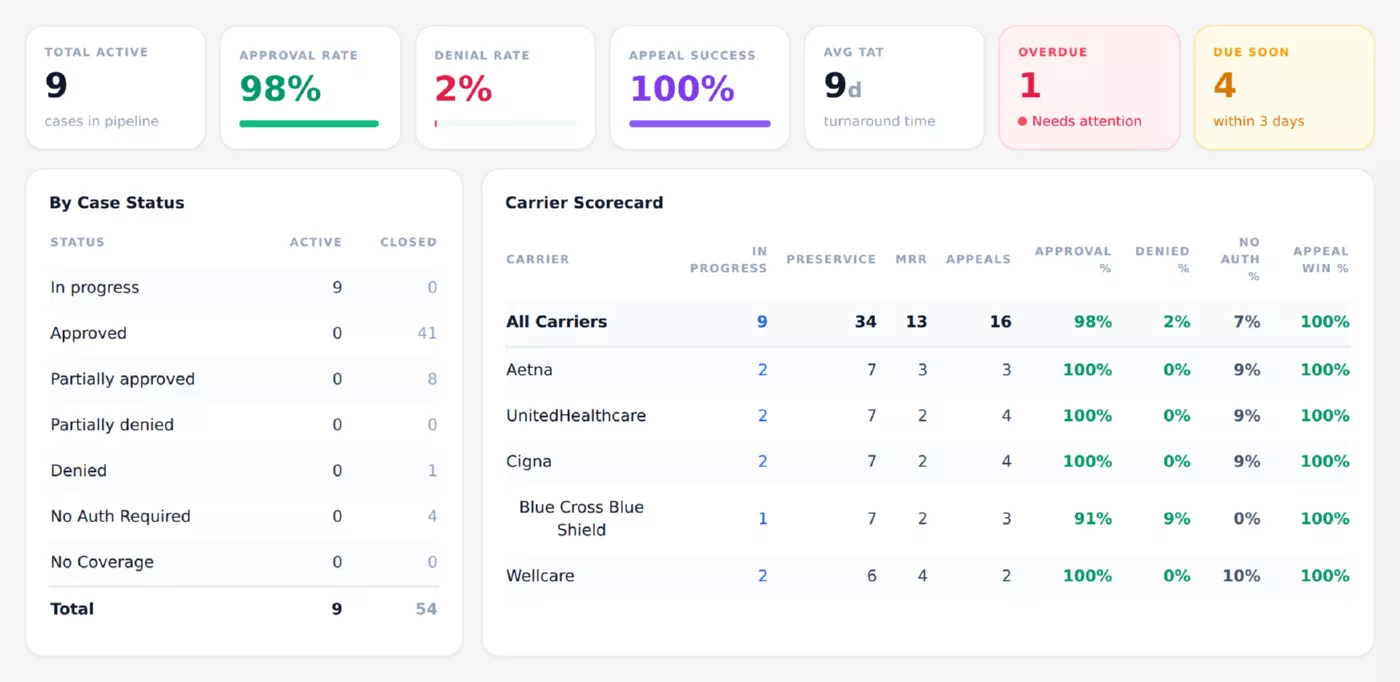
A book of business you can actually run
Approval and denial rates, appeal outcomes, turnaround time, and what is overdue right now — per payer, across the whole practice. No spreadsheet reconciliation, no month-end guesswork.
Regulatory clocks
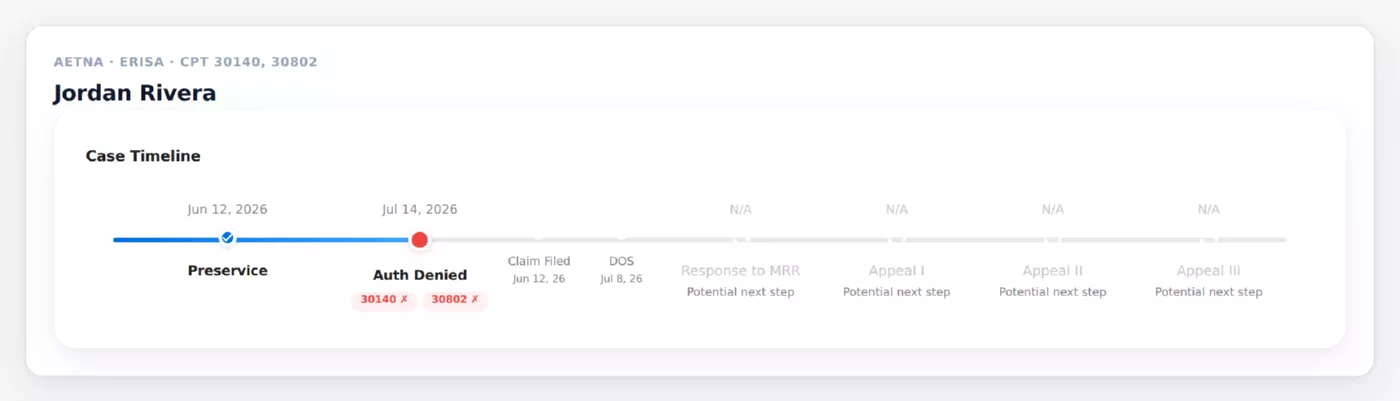
Every deadline the framework gives you, tracked
ERISA, Medicare, Medicaid, Tricare and FEHB each set their own response windows. OutClaim tracks the clock that governs each case, shows the next step before it is due, and marks what has run out of time.
Records audit
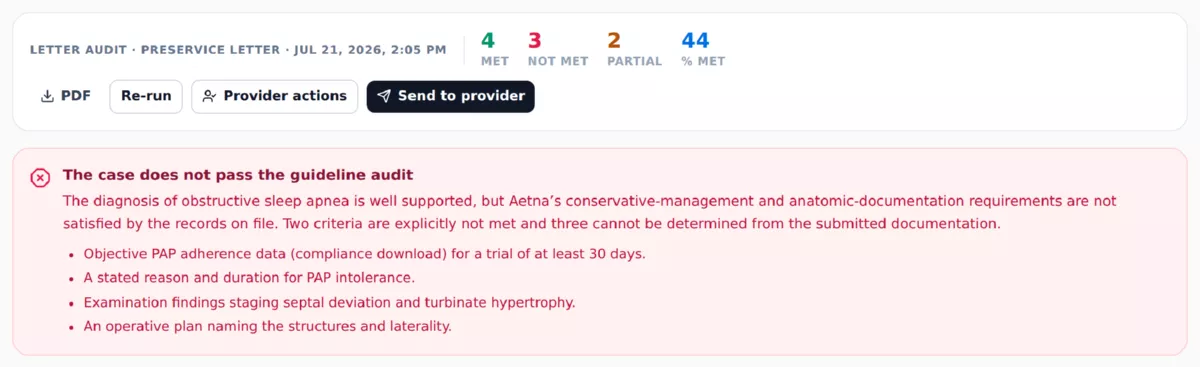
The gaps get found before the payer finds them
Every letter is checked against the governing policy criterion by criterion. What the record supports, what it doesn't, and what can't be determined — stated plainly, with the missing item named, before anything goes out the door.
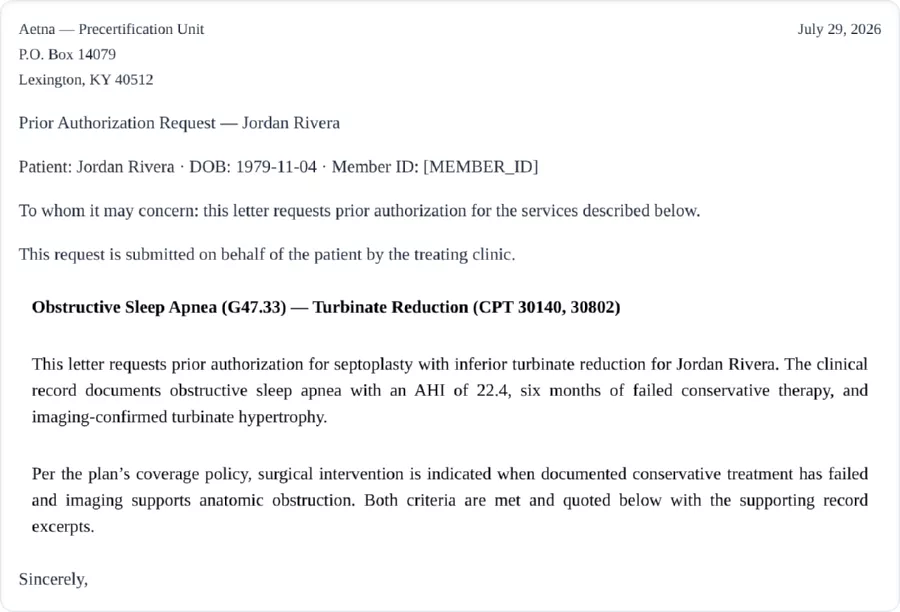
Correspondence
Written to the rule, not to a template
Preservice requests, records responses and appeals are generated against the payer's own policy and the governing framework — citing the criterion, quoting the record, and stating the obligation.
Appeals
A case-specific strategy, not a form letter
OutClaim reads the denial and the record, then proposes the arguments that are actually available — ranked by strength, with the supporting evidence attached and any acknowledged gap stated up front.
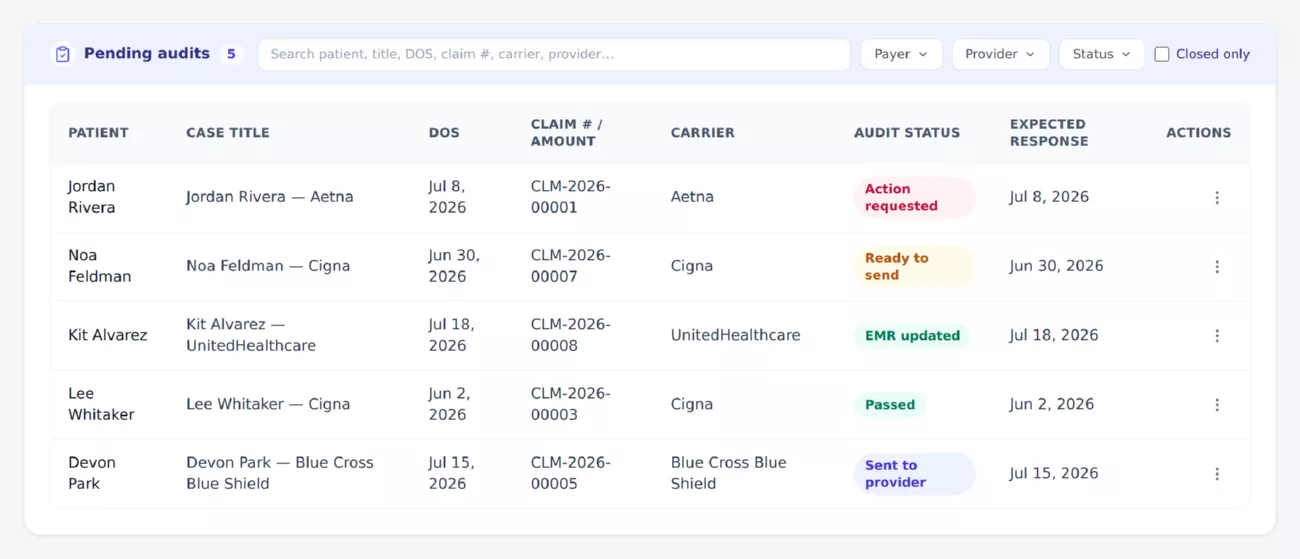
The work queue
Your team always knows what is next
Cases waiting on the clinic, cases waiting on a provider, cases ready to send. One list, in priority order, with the expected response date on every row.
Three steps, inside the workflow you already have
Build the case
Add the patient, the codes and the payer. OutClaim identifies the policy that governs the decision — including where a delegated vendor's rule book applies instead of the payer's own.
Audit the record
The record is tested against that policy before anything is sent. Gaps are named, and routed to the provider when clinical input is what's missing.
Establish the obligation
The correspondence goes out citing the rule and the record. The clock starts, and OutClaim tracks what the payer owes you and when.
Expertise, Strategy, Consulting
OutClaim clients not only have access to technology; they partner with the expert who built it.
As part of the engagement, clients receive
-
Strategic guidance and oversightfrom Dr. Ludwick, the physician behind the platform
-
Coachingon how to think differently about insurer engagement
-
Supportin shifting teams from defensive habits to an offensive posture
Why This Was Never Fixed (Until Now)
The rules requiring insurers to be specific, transparent, and accountable have always existed. What was missing:
-
KnowledgeMost providers have never heard of ERISA, or do not understand how to use it properly; they're often simply unaware of all the strategies available to them. OutClaim provides the knowledge and its proper application.
-
The right playbook.Billers and staff have been conditioned by the insurance companies to be shown how to get paid, how to appeal, how to obtain authorizations — all defensive strategies. OutClaim provides the offensive playbook designed to get providers paid.
-
ScaleEven with the knowledge and the correct playbook, it would be impossible to apply at scale. OutClaim changes all of that
OutClaim Is For Leaders Who Want to Operate on Offense
Designed for specialty physician groups and revenue leaders who want control earlier in the process and are tired of budgeting around insurer uncertainty.
- Specialty physician groups
- Revenue cycle leaders
- Practice administrators
- Billing teams
If your goal is predictable payment, OutClaim is for you.
It fits the workflow your team already has
In a short, working demonstration, see how OutClaim fits into your existing workflow — without system integrations, long-term commitments, or retraining your team. OutClaim is easy for your billing staff to use. Minimal setup and no disruption.
No disruption
Fits the process you run today
No retraining
Built for the billing staff you already have
No long-term contracts
Stay because it works
Just clarity
From the beginning
The argument is built from your record and the payer's own policy
AI is the delivery mechanism, not the author of record. Letters quote the payer's own policy language and your documentation — the AI isn't writing from memory, and nothing goes out on its own.
Grounded, not generated
Every assertion is tied to the payer's published criterion and to a specific line in your clinical record. Where the record doesn't support a criterion, the letter says so rather than papering over it.
Your team approves everything
Every letter is reviewed and approved by your staff before it is used. The platform prepares the argument; the decision to send it stays with you.
Model-agnostic by design
We route each task to the best-fit model and upgrade the moment a better one proves out — with no vendor lock and nothing for your team to change.
One compliance boundary. Zero retention outside it.
Patient data is not an afterthought bolted onto a marketing product. We operate as your Business Associate, under a BAA signed before any protected health information moves.
AI governance
- HIPAA-compliant setup with every AI provider, under signed BAAs.
- Never used for training. Patient data is never used to train models and is never retained on provider servers.
- US-based providers only, with data centers contractually within the US mainland.
- Minimum necessary. Only the context a given task requires is ever sent.
Platform security
- AES-256 encryption of patient identifiers, demographics and document text, on top of encrypted-at-rest storage and TLS everywhere.
- No public exposure. Patient documents live in private storage, reachable only after a permission check on every request.
- Separation between clinics is enforced in the database itself — and verified automatically before every release.
- MFA sign-in, least-privilege access, and a tamper-evident audit log of every access to patient data.
Deployment
- Managed service inside OutClaim's HIPAA boundary — nothing for your team to host, patch or secure.
- Nothing to install. A web application your staff signs into from the browser.
- Controlled disposal. Deleting a document removes the stored file, and the deletion is recorded.
- Continuous improvement ships without upgrade projects on your side.
The boundary is the point.
Patient data lives inside OutClaim's HIPAA boundary. The AI sees only what a single letter requires, retains nothing, and never becomes a place your data lives.
HIPAA Security Rule safeguards, at a glance
Administrative
- Documented security program: risk analysis and ongoing activity review
- Least-privilege workforce access — reviews, training, offboarding
- Incident-response and breach-notification runbooks
- BAAs with every provider that may touch PHI
Physical
- Data centers operated by major cloud providers under their own compliance programs
- Managed, disk-encrypted devices for production access
- Controlled disposal of patient files, recorded in the audit log
Technical
- Unique accounts, MFA, verified sessions
- AES-256 field encryption and TLS on every connection
- Tamper-evident audit log of every PHI access
- Integrity controls — changes only through permission-checked paths
Start with the cases you already have, not an IT project
What we'd need from you
- 01
Your payer list
Which insurers and plan types you deal with — commercial/ERISA, Medicare Advantage, Medicaid, Tricare, FEHB.
- 02
The codes you fight most
Your common CPT and ICD combinations.
- 03
Payer policies, if you have them
Optional — we pull public coverage policies ourselves.
- 04
Who needs access
A name and email for each user.
How a trial runs
- 01
Onboarding day
Bring a handful of real cases — three to five upcoming prior auths and denials, with the auth requests, denial letters, EOBs and clinical notes you already have as PDFs.
- 02
Run it in a controlled setting
One location or one specialty, so you can measure results before and after.
- 03
Scale when ready
Expand once the numbers are yours, not ours.
What practices ask first
Do we have to integrate OutClaim with our EMR or billing system?
No. OutClaim works alongside the systems you already run — no system integrations, and nothing to rip out. That is deliberate: the value shows up in the first cases you put through it, not after a six-month implementation.
Will our billing team need retraining?
No. OutClaim is built for the billing staff you already have, and fits into your existing workflow. Minimal setup, no disruption.
Is this just template letters with AI on top?
No. The correspondence is generated against the payer's own policy and the governing framework — ERISA, Medicare, Medicaid, Tricare or FEHB — citing the specific criterion and quoting the record. No templates, no opinions, no grey areas. The strategy is built per case, not selected from a library.
What happens when the record doesn't support the claim?
OutClaim tells you before the letter goes out. The audit names the criterion that isn't met and what is missing, and routes the question to the provider when clinical input is what's needed. Nothing is sent claiming support that isn't in the record.
Are we locked into a contract?
No long-term contracts. Plans are monthly, and early-access pricing is available now.
How is patient data protected?
We operate as your Business Associate under a signed BAA. Sign-in requires multi-factor authentication and access is least-privilege; patient identifiers, demographics and document text are encrypted with AES-256 on top of encrypted-at-rest storage and TLS; separation between clinics is enforced in the database itself; and every access to patient data is written to a tamper-evident audit log.
Is our patient data used to train AI models?
No. Patient data is never used to train models and is never retained on any AI provider's servers. We work only with US-based providers under signed BAAs, with data centers contractually within the US mainland, and only the minimum necessary context for a given task is ever sent.
Does the AI send letters on its own?
Never. Your team reviews and approves every letter before it is used. The platform prepares the argument — quoting the payer's own policy language and your documentation — and the decision to send stays with you.
What do you need from us to start?
Your payer list, the CPT/ICD combinations you fight most often, names and emails for the people who need access, and a handful of real cases — three to five upcoming prior auths and denials with the documents you already have. Payer policies are optional; we pull public coverage policies ourselves.
Apply for early access to OutClaim. In a short, working demonstration, see how it fits into your existing workflow — no integrations, no long-term commitments, no retraining.
All fields required